Guest Posts vs Link Insertions: Which Boosts SEO More?
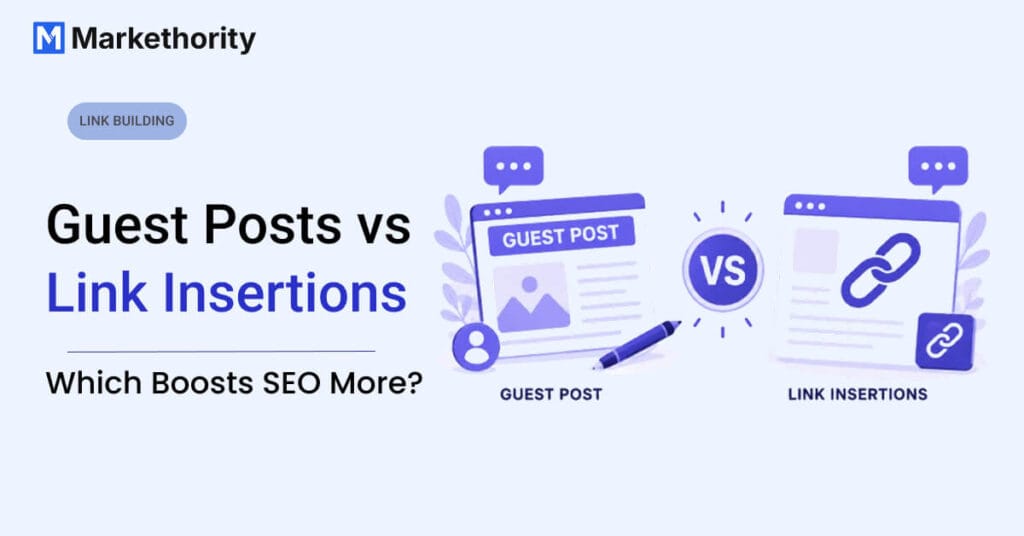
Link building has two workhorses: guest posts and link insertions.
Both bring in contextual backlinks. Both can push rankings. But they work in different ways, cost different amounts, and suit different stages of an SEO campaign.
If you’ve been staring at both options wondering which one actually moves the needle more — this is the breakdown you need. No vague answers. Just a clear look at how each strategy performs, where each one wins, and how to think about using them together.
Table of Contents
What Is Guest Posting?
Guest posting means writing an original article and getting it published on someone else’s website. The article includes a contextual backlink to your site — placed naturally within the content, not buried in a sidebar or footer.
The best guest posts go on websites with real editorial standards and genuine organic traffic. The article has to be worth publishing on its own merits. Your link just happens to live inside it.
Done right, a guest post gives you three things at once: a quality backlink, brand exposure to a new audience, and a piece of content that keeps sending referral traffic for months.

What Are Link Insertions?
Link insertions — also called niche edits — skip the new content entirely. Instead, you find articles that are already live, already indexed, and already ranking on relevant websites. Then you work with the site owner to place your link inside that existing piece.
The logic behind this is simple. The page has already done the hard work of building authority. Your link gets to benefit from that immediately, rather than waiting for a new article to earn its own standing over time.
For campaigns where speed matters, this is a serious advantage.

How They Compare: The Real Differences
Speed of Results
Link insertions win here. Pages that already have traffic and domain authority pass that value to your site quickly after the link goes live. Ranking movement within two to four weeks is common.
Guest posts take longer. A freshly published article needs time to get indexed and build its own authority before it starts contributing meaningfully. Depending on the site, that process can take anywhere from a few weeks to a couple of months.
Control Over Anchor Text
Guest posts give you full control. You write the article, choose the topic, and decide exactly how the link is placed and what anchor text it uses.
With link insertions, you’re editing around content that already exists. Anchor text can usually be negotiated, but the surrounding context isn’t built to serve your strategy the way a purpose-written article is.
Cost Per Placement
Link insertions cost less. There’s no article to write, no editorial process to manage from scratch. Publishers are editing an existing page, which means less work and lower fees.
Guest posts cost more because more work goes into them — research, writing, pitching, revisions. But you’re also getting brand visibility and referral traffic as part of the deal, not just an SEO backlink.
Brand Exposure and Referral Traffic
Guest posts are the clear winner here. A well-placed article on a respected website introduces your brand to real readers. Some of them click through. Some of them convert. That referral traffic is a real business outcome that exists entirely separately from the SEO value.
Link insertions don’t deliver that. The link does its SEO job, but nobody reads the host article thinking about your brand.
Long-Term Stability
Guest posts tend to stay live longer. An article commissioned through a proper editorial process has a reason to exist on the site. Publishers rarely remove content they chose to publish.
Link insertions are edits to someone else’s content. Most stay live indefinitely, but there’s a slightly higher chance of removal during a future site audit. Reputable publishers minimize this risk significantly.
EEAT: What Google Is Actually Looking For
Google’s quality guidelines are built around Experience, Expertise, Authoritativeness, and Trustworthiness. Both link types contribute to this — just in different ways.
Guest posts support the Experience and Expertise side. Publishing well-researched content on respected websites signals to Google that real, knowledgeable people are associated with your domain. Over time, this builds topical authority that compounds.
Link insertions support the Authoritativeness and Trustworthiness side. Being referenced by established, relevant websites tells Google your domain belongs in the conversation for your topic.
A strong backlink profile in 2026 has both. Guest posts fill the expertise gap. Link insertions fill the authority gap. Neither fully replaces the other.
AI Overviews: How to Get Your Content Cited
Google’s AI Overviews pull answers from content that is clear, well-structured, and written with genuine authority. This changes how you should think about link building.
Guest posts on high-authority editorial sites have a better chance of being picked up by AI search than link insertions do. AI systems look for comprehensive, well-organized content written by credible sources — a quality guest post fits that description better than a link tucked into an old article.
That said, the domain authority built through both strategies makes your own website’s content more likely to surface in AI-generated answers. The direct path to AI visibility runs through guest posts. The foundational path runs through both.
To optimize specifically for AI Overviews: write guest posts that answer specific questions clearly and completely, use structured headings, include data where possible, and publish on sites that already get cited in AI answers in your niche.
When Guest Posting Makes the Most Sense
Use guest posting as your primary strategy when you’re building from early-stage authority. A newer domain needs editorial backlinks — the kind that come with real content and real context — more than it needs link insertions in aged articles.
It’s also the right call when your audience reads specific publications. For SaaS brands and B2B companies, getting featured on industry-relevant sites isn’t just an SEO tactic — it puts your brand in front of the exact people who might buy from you.
And when thought leadership is part of your goals, guest posts are the only strategy that delivers. A well-placed article with your name on it builds professional credibility that a link insertion cannot replicate.
When Link Insertions Make the Most Sense
If you need ranking movement in the next 30 to 60 days, link insertions are the faster route. Pages that are already indexed respond to new link equity more quickly than fresh content does.
They’re particularly effective for pages already sitting in positions eight through fifteen. These pages don’t need more brand content around them — they need more link equity flowing to them. Link insertions deliver that cleanly.
Budget-constrained campaigns also benefit from link insertions. Lower cost per placement means you can build more quality links with the same spend — which matters in competitive niches where volume is part of the equation.
The Case for Running Both
Most experienced SEOs don’t choose between these two strategies. They use both, because they cover different gaps in a backlink profile.
A practical approach: start with guest posts to build topical authority and brand presence, while layering in link insertions to generate faster movement on priority pages. As the campaign matures, the guest posts compound — the articles gain their own authority, referral traffic builds, and your brand becomes more recognized. The link insertions, meanwhile, have already delivered early wins.
New domains should lean heavier on guest posts early. Established domains pushing competitive rankings can shift more budget toward link insertions for specific pages. Growing businesses that need both brand exposure and ranking speed should run both from the start.
Common Mistakes to Avoid
With Guest Posting
Prioritizing quantity over quality is the biggest mistake. Twenty articles on low-traffic sites with no real editorial standards produce less value than two articles on sites that genuinely matter. Every placement needs to be vetted for real traffic, not just domain rating.
Over-optimizing anchor text is another trap. If most of your guest post backlinks use the same exact-match keyword as anchor text, it looks unnatural. A healthy mix of branded, partial match, and varied anchors is safer and more effective.
With Link Insertions
Buying bulk placements from unvetted marketplaces is where most link insertion campaigns go wrong. Cheap link insertions are cheap because the sites aren’t good. A link from a low-quality site does nothing at best and can hurt you at worst.
Context matters as much as domain quality. A link dropped awkwardly into an article that has nothing to do with your niche isn’t fooling anyone — including Google. Relevance isn’t a checkbox. It’s what makes the link work.
Frequently Asked Questions
Which is better for a new website — guest posts or link insertions?
Guest posts. New domains need editorial authority first. A few well-placed guest posts on established sites build the foundation that makes everything else work faster later.
How fast do link insertions show results?
Usually two to four weeks on pages that already have traffic. Pages stuck between positions 11 and 20 often respond even faster.
Are link insertions safe after Google’s updates?
Yes — when done on real, relevant websites through proper outreach. Google targets manipulative patterns and spammy placements, not white-hat link building through genuine publisher relationships.
Can I run both at the same time?
Yes, and in most cases you should. Guest posts build long-term authority. Link insertions deliver faster results. Running both means you’re not trading one goal for the other.
What ratio of guest posts to link insertions should I use?
New sites: lean 70/30 toward guest posts. Established sites targeting competitive pages: closer to 50/50. There’s no fixed rule — it depends on your domain’s current authority and what you’re trying to achieve.
Do guest posts help with Google’s AI Overviews?
More than link insertions do, yes. AI systems pull from well-structured, authoritative content. A quality guest post on a respected site fits that better than a link in an existing article.
How do I know if a site is worth placing a link on?
Check organic traffic first, not just domain rating. A site with real monthly visitors and editorial standards beats a high-DR site with no audience. If a real person in your target niche wouldn’t read it, the link probably isn’t worth much.
Is guest posting the same as sponsored content?
Not exactly. Genuine guest posts involve editorial review and are accepted based on content quality. Sponsored content is paid placement with less editorial scrutiny. Google treats the two differently — quality editorial placements carry more weight.
Final Thoughts
To wrap things up — guest posts and link insertions both have real value. Stop trying to pick a winner between the two. Just figure out where your site is right now and let that guide your decision.
Guest posts are the right investment when authority, brand visibility, and anchor text control are the priority. Link insertions earn their keep when speed and budget efficiency matter most, or when you need to push pages that are already close to ranking.
The campaigns that consistently outperform are the ones using both — timed well, executed on quality sites, and adjusted as the results come in.
About the author
Mansi is a Link Building Specialist at Markethority, helping SaaS and tech brands earn high-quality backlinks through manual outreach and publisher relationships. She writes about link building, guest posting, and SEO based on real-world campaigns, sharing practical strategies that support long-term organic growth.