Let’s be honest — most link building content you find online is the same recycled advice dressed up in a new headline. “Personalize your emails.” “Find broken links.” “Write good content.” You already know all of that. What you probably don’t know is why your campaigns aren’t converting, or why you’re getting a 2% response rate when other people claim they’re hitting 20%.
The problem is not a lack of tactics. It’s the lack of a clear link building outreach strategy that turns those tactics into a repeatable process. Most marketers jump straight into sending emails without knowing who to target, what value to offer, or how to follow up effectively.
This guide is not going to waste your time with fluffy definitions. If you’re reading this, you’re likely someone who’s tried outreach before, got frustrated with the results, and wants a real playbook for 2026, not a repackaged version of what worked in 2018.
So let’s get into it.
What Is Link Building Outreach
At the simplest level, link building outreach is when you reach out to another website and ask them to link to your content. That’s it. But the gap between that simple definition and actually getting links at scale is where most people get stuck.
The word “outreach” sounds polished, but the reality is messier. You’re essentially cold-emailing strangers and asking for a favor. The websites you’re targeting get dozens of these emails every single day. Most of them are terrible — generic, transactional, obviously copy-pasted. Which is actually good news for you, because if you do this even slightly better than average, you’ll already stand out.
Link building outreach is not just an SEO tactic. Done right, it’s also how you build real relationships with people in your industry — editors, bloggers, journalists, content managers. Those relationships compound. The editor who placed your link this month might reach out to you for a quote next month. That’s how authority actually builds.
Table of Contents
Why Link Building Outreach Still Works in 2026
Every year someone writes the “is link building dead?” article and every year the answer is the same: no. But let’s talk about why it still works, because the reasons have evolved.
The SEO Case Is Still Strong
Google has gotten better at understanding content quality and user intent, but it has not replaced links as a trust signal. Links are still one of the clearest ways Google has to understand which pages are respected by other publishers. A high-quality backlink from a relevant site in your niche tells Google something that no amount of on-page optimization can replicate.
What has changed is that low-quality links — spammy directories, link farms, irrelevant blog comments — carry less weight than they used to and can actively hurt you. The bar for what counts as a “good” backlink has gone up. That’s exactly why manual outreach, which targets real websites with real audiences, is more valuable now than it’s ever been.
Authority Takes Time, and Links Accelerate It
If you publish great content and just wait for people to naturally link to it, you might be waiting for years. Most great content never gets linked to simply because nobody knows it exists. Outreach is how you shorten that gap — you’re putting your content in front of the right people at the right time instead of hoping they stumble across it.
Referral Traffic Is Often Underrated
People focus so heavily on the SEO value of backlinks that they forget the other benefit: actual traffic. A link from a well-read industry newsletter or a popular resource page can send hundreds or thousands of targeted visitors to your site — people who arrive with context, trust, and intent. That kind of traffic often converts better than organic search traffic.
According to Backlinko’s analysis of millions of search results, pages with strong backlink profiles continue to outperform pages with few or no backlinks.
Types of Link Building Outreach
Before you build a strategy, you need to know which type of outreach fits your situation. Each approach has different effort levels, different conversion rates, and different use cases.
Guest Post Outreach
This is the most common type, and also the most misused. Guest posting means you write a full article for another website in exchange for a backlink — usually placed naturally within the content or in the author bio.
The reason guest posting gets a bad reputation is because people abuse it. They pitch low-effort articles to low-quality sites just to get the link, and Google has gotten pretty good at identifying and discounting those. The guest posts that actually move the needle are the ones where you’re writing genuinely useful content for a site your target audience actually reads.
A real example
Say you run a recruitment software company. You identify an HR publication that publishes content your potential customers actually read — articles on hiring processes, remote team management, that kind of thing. You pitch them a piece like “Why Your Job Descriptions Are Driving Away Qualified Candidates” — something specific, data-backed, and genuinely useful to their readers. Within that article, you naturally reference a resource on your own site. That link earns real authority and drives relevant traffic.
The pitch matters as much as the content. A lot of people write a decent article idea but send it to the wrong person, or frame it in a way that sounds like they’re asking for a favor rather than offering one.
Link Insertion Outreach
Link insertion — sometimes called niche edits — is when you find an existing, already-published article on another site and ask the editor to add your link into it as an additional resource. No new content needs to be written. If the editor agrees, they simply drop your URL into a relevant sentence or add it to a resource section.
This approach works because it’s low-effort for the other person. You’re not asking them to commission new content. You’re asking them to improve something they’ve already published — and if your resource genuinely adds value to their article, it’s a compelling case.
A real example
You’ve published a comprehensive, well-researched guide on technical SEO audits. You find a marketing blog that has an article titled “How to Improve Your Website’s Google Rankings” — it covers the basics but barely touches on technical SEO. You email the author and say something like: “Hey, I noticed your guide doesn’t go deep on the technical side — we published a detailed audit framework that might be useful for your readers. Happy to share it if you think it fits.” That’s it. No pressure, just a genuine offer.
The key with link insertion outreach is making sure your content actually belongs in that article. Editors can tell when a pitch is just someone trying to shoehorn a link into irrelevant content.
Broken Link Building
Broken link building is clever because it flips the dynamic — instead of asking someone for something, you’re leading with a favor. You find a link on their site that’s no longer working (returning a 404 error), flag it for them, and suggest your content as a replacement.
Webmasters genuinely dislike broken links. They hurt user experience, and on some level, every dead link on a site is a small embarrassment. When you reach out to flag one, you’re doing them a service before you make your ask. That changes the tone of the entire conversation.
Tools like Ahrefs, Screaming Frog, and the Check My Links Chrome extension make it relatively straightforward to find broken links at scale. You find the dead link, check what the original page was about (using the Wayback Machine if needed), and then see if you have content that could serve as a replacement.
A real example
An SEO resource site has a roundup article linking to a “Top SEO Tools Comparison 2022” page that no longer exists. You’ve published an updated 2026 version of a similar comparison. You email the site editor: “Hey, I came across your article while researching SEO tools — noticed the link to [dead URL] is returning a 404. I recently put together an updated comparison that covers a lot of the same ground and might work as a replacement.” That’s a completely different energy from “please link to my article.”
Digital PR Outreach
Digital PR is where link building crosses over into traditional PR and content marketing. Instead of targeting individual bloggers or editors, you’re creating content specifically designed to be newsworthy — original research, data studies, surveys, expert roundups — and pitching it to journalists and publications.
The upside is that a single successful digital PR campaign can earn you dozens of high-authority links from news sites, industry publications, and major online magazines in a short period of time. The downside is that it requires significantly more upfront investment and the success rate per pitch is much lower.
This approach works best for businesses that have access to interesting data — either from their own platform, from customer research, or from original surveys they’ve commissioned. Journalists love exclusives and novel data. Give them something genuinely new to write about and you’ll get links that no amount of blogger outreach could match.
Step-by-Step Link Building Outreach Strategy
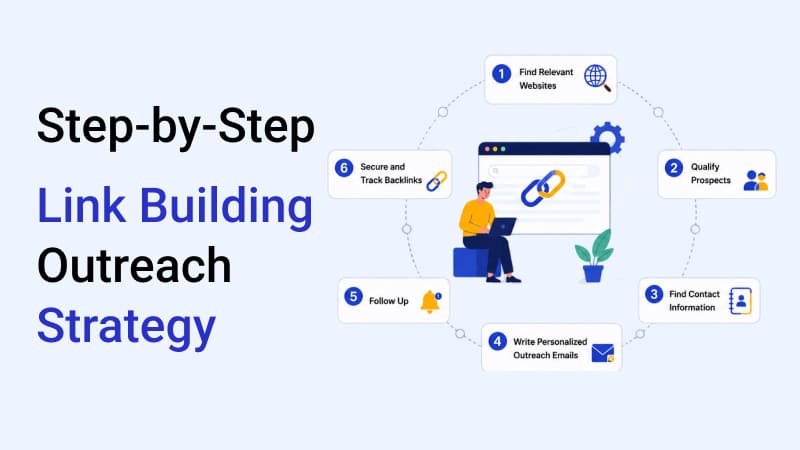
Here’s the actual process — not the theoretical version, but what this looks like when you’re building a campaign from scratch.
Step 1: Find Relevant Websites
Relevance is the word you’ll hear most in link building, and it deserves more explanation than it usually gets. A “relevant” website isn’t just one that’s loosely in your industry. It’s a site where the specific page you want a link from is topically connected to the specific page on your site you’re trying to build authority for.
A backlink to your email marketing guide from an article about email marketing strategies is relevant. A backlink to the same guide from an article about social media advertising is much less so — even if both are on marketing blogs.
How to find good prospects:
- Search for your target keyword and look at what’s ranking on pages 2-5 of Google. Those sites are clearly in your space and often receptive to outreach because they know they need content help.
- Use Ahrefs’ Content Explorer to find high-traffic articles on your topic. The sites publishing that content are your natural targets.
- Look at who’s linking to your competitors’ top pages — those sites have already shown they link out in your niche.
- Search Google for “[your topic] + resources” or “[your topic] + further reading” to find resource pages that add links by design.
Build a spreadsheet with: site URL, specific page URL, domain rating, estimated traffic, and a column for your contact notes. Keep it simple.
Step 2: Qualify Prospects
Not every site that’s “relevant” is worth targeting. Run through this quick checklist before spending time crafting a personalized pitch:
Is the domain rating above 20? (Below that, the link likely carries minimal SEO value.) Does the site get real traffic? Check Ahrefs or Semrush — a site with DR 50 but zero traffic is probably penalized or inactive. Is the content recent? A site that hasn’t published anything in two years is probably not going to respond to your email. Does it look like a real publication? If the site is clearly a private blog network, content farm, or link scheme, walk away.
You don’t need to be rigid about these. A highly relevant site with DR 18 and genuine readership might be worth more than a generic DR 60 site with no audience overlap. Use judgment.
Step 3: Find Contact Information
Generic contact forms and info@ addresses almost never work. You need to find the actual person responsible for content.
For blogs and smaller publications, the author bylines usually link to profiles — those profiles often include Twitter handles or LinkedIn pages where you can find an email or even DM directly. For larger publications, LinkedIn is your friend: search the company name and filter for roles like “content manager,” “editor,” or “head of content.”
Hunter.io is the go-to tool for finding email formats from a domain. You type in the website URL and it shows you verified emails and the email format the site uses (like firstname@domain.com), so you can make an educated guess even when the exact address isn’t listed.
Always verify before you send. A bounced email hurts your sender reputation and could affect future deliverability.
Step 4: Write Personalized Outreach Emails
This is the step where most campaigns live or die, so it deserves the most attention.
The first thing to understand is that personalization is not just dropping someone’s first name and their article title into a template. Real personalization means you actually read what they published, you understood it, and your email reflects that. Editors read hundreds of pitches and they can spot a fake “I loved your article on [topic]” instantly.
What actually works:
Make the subject line specific. “Quick thought on your [exact article title]” outperforms “Collaboration opportunity” every single time. Specificity signals that you’re a real person who read their content.
Open with something genuine. Not a compliment factory, but a real observation. “I came across your piece on [topic] while looking into [specific thing] — the section on [specific part] cleared up something I’d been confused about.” That’s one sentence, and it proves you actually read the thing.
State what you’re offering and why it helps them. Keep this short. “I wrote a guide on [your topic] that goes into [specific detail your content covers]. I think it could be a good addition to your [section/article] for readers who want to go deeper.” No fluff, no over-selling.
End with one clear ask. Don’t give them multiple options or ask them to “let me know what you think.” Ask the specific thing you want: “Would you be open to linking to it?” or “Would this be a fit for a guest post?”
Keep the whole email under 150 words. Shorter is almost always better.
Step 5: Follow Up
This step gets skipped more than any other, and it’s a massive mistake. The majority of positive responses — in most campaigns, the majority — come from follow-up emails, not the initial pitch. People are busy. Inboxes are full. Your email got read, flagged as interesting, and then buried under twelve other things.
A polite follow-up three to five days later is not annoying. It’s expected. The key is keeping it brief and not guilt-tripping. “Just bumping this up in case it got buried — totally understand if it’s not a fit, but happy to share the link if useful” is perfectly fine.
Send a second follow-up five to seven days after the first if you still haven’t heard back. After that, move on. Three total emails (initial + two follow-ups) is the right limit. Going beyond that crosses a line and burns bridges you might want to use later.
Step 6: Secure and Track Backlinks
When someone says yes, don’t let the momentum die. Respond quickly, send exactly what you promised, and confirm the details — which page your link goes on, what anchor text will be used, and a timeline for when it goes live.
Once the link is placed, verify it using Ahrefs or Google Search Console. Check that the link is dofollow (unless the site specifically only does nofollow, in which case decide if the referral traffic value still makes it worthwhile), that it points to the right page, and that the anchor text makes sense contextually.
Maintain a tracking sheet or use a tool like BuzzStream, Pitchbox, or even a simple Notion database with columns for: prospect site, DR, contact name, outreach date, follow-up dates, response received, link URL, anchor text, and link live date.
Reviewing this data every month will show you which types of sites respond most, which email styles convert best, and where you should be doubling down.
Link Building Outreach Email Template
Most outreach emails never get a reply. And the reason usually isn’t that the link was irrelevant — it’s that the email felt like it was blasted to a thousand people at once. You can tell within the first line.
The templates below don’t look like templates. That’s the whole point. Yes, there are brackets — but those aren’t for automation. Every single one needs to be filled in manually, for that specific person, that specific article, that specific reason you’re reaching out. It takes longer. It also actually works.
1. Link Insertion Email
Use this when you want a site to add your link inside a post they’ve already published.
Subject: Your [specific article title] — one small addition?
Hi [First Name],
I was going through your article on [specific topic] earlier this week — the bit where you explained [specific point] was genuinely one of the clearer takes I've read on it. Passed it along to a couple people on my team.
One thing I did notice — you don't really get into [specific subtopic]. We've put something together on that: [your URL]. Your readers are already interested in [broad topic], so it might be a natural fit for that section.
Either way, no pressure. Just thought it was relevant enough to mention.
[Your Name]
Short, specific, and it doesn’t beg. That’s why it works.
2. Guest Post Outreach Email
Use this when you want to write a brand new article for someone else’s blog — with your link included naturally in the content.
Subject: A post idea for [Blog Name] — worth a look?
Hi [First Name],
I've been reading [Blog Name] on and off for a while. Your piece on [specific article] actually made me rethink how I approach [specific thing] — good stuff.
I had an idea for a post that I think would land well with your audience: [Proposed Title]. It covers [one-line description] — the kind of topic your readers clearly care about but most articles either skip or half-explain.
I'd write it from scratch, only for your site. Nothing that's been published elsewhere.
Let me know if it's worth exploring?
[Your Name]
The pitch only works if it feels like it was written for that blog specifically — not something you already wrote and are now trying to find a home for.
3. Listicle Link Email
Use this when a site has a roundup or “best of” post and your resource genuinely belongs on it.
Subject: Might be worth adding to your [Listicle Title]?
Hi [First Name],
Stumbled across your roundup on [topic] — really solid list, bookmarked it straight away.
One thing I noticed though — [your resource] isn't on there. We've put together [brief description] at [your URL], and it's been useful specifically for [use case your audience cares about]. Based on what's already on your list, I think it'd fit well around #[position] — right after [specific existing item].
Completely your call. Just thought it was worth flagging.
[Your Name]
Mentioning the exact spot — “right after #5” — tells them you actually read the list. That small detail changes the response rate more than any subject line trick ever will.
Common Outreach Mistakes to Avoid
Sending the same email to 500 people. Mass outreach with minimal personalization has a response rate close to zero in 2026. Sites get too much of this to take it seriously anymore.
Pitching irrelevant sites. A link from a lifestyle blog to your B2B software company is not useful and editors of those blogs know it — the pitch immediately signals you’re not paying attention.
Over-explaining why you need the link. Nobody cares about your domain authority goals. They care about their readers. Write every email from that angle.
Ignoring follow-ups. If you’re not following up, you’re leaving a significant portion of potential links on the table. Build follow-ups into your workflow from day one, not as an afterthought.
Not checking the site before you pitch. Pitching a guest post to a site that hasn’t accepted outside submissions in two years — or that explicitly says “we don’t accept guest posts” on their contact page — is an immediate credibility hit.
Best Practices for Successful Outreach in 2026

Build the relationship before you need the link. If you’ve been sharing someone’s content, engaging with their posts on LinkedIn, or even just leaving a genuinely useful comment on their articles — when you reach out, you’re not a cold stranger anymore. Warm outreach converts at a dramatically higher rate than cold.
Focus your energy on fewer, better prospects rather than blasting hundreds of sites with weak pitches. Fifty highly targeted, genuinely personalized outreach emails will almost always outperform five hundred generic ones.
Diversify your anchor text naturally. If every link pointing to your page uses the same exact keyword phrase as the anchor text, that’s a signal to Google. Mix in branded anchors, partial matches, and natural phrases like “this guide” or “more detail here.”
Regularly audit your backlink profile. New toxic links can appear without you doing anything — negative SEO is real, and you want to catch and disavow problematic links before they create issues.
FAQs
What is link building outreach?
It’s the process of proactively contacting website owners and editors to earn backlinks to your content. You identify sites where a link to your content would make sense, find the right contact person, and send a personalized pitch that explains why linking to you would benefit their readers.
Is link building outreach still effective in 2026?
Yes, and it’s arguably more effective than ever for the right sites because so many businesses are doing it poorly. The bar for what passes as a “good” outreach email has shifted — generic templates don’t work anymore. But if you’re doing it with real personalization and a genuine value proposition, you’ll stand out easily.
What is a good outreach response rate?
For cold outreach in most niches, 5–10% is average. If you’re hitting 15–25%, you’re doing well. The metric that actually matters more is your placement rate — how many responses convert into actual live links. Aim to close at least 50% of positive responses into placements.
How many follow-ups should I send?
Two. One initial email, one follow-up after four to five days, one final follow-up five to seven days after that. Three total touchpoints is the right balance between persistence and respect. After three emails with no response, move on.
Conclusion
Link building outreach is not a growth hack. It’s not a quick win. It’s a long game — one that rewards consistency, genuine relationship-building, and a real commitment to offering value rather than just extracting it.
The businesses that win at backlink outreach in 2026 are the ones treating it like business development, not like a checkbox on their SEO to-do list. They’re building real connections with publishers in their space, creating content that’s actually worth linking to, and running their campaigns with the same discipline and tracking they’d apply to any other revenue-generating activity.
If you approach outreach that way — one good email, one genuine relationship, one quality link at a time — the results will compound in ways that no shortcut ever could.