If you’ve spent any time doing white hat link building, you already know the real challenge isn’t writing the post — it’s figuring out how to find high-quality guest post opportunities in the first place. Anyone can find a site willing to publish anything. Finding guest posting websites that actually move your organic rankings, send referral traffic, and build genuine topical authority is a different skill entirely.
Table of Contents
Why Guest Posting Still Works in 2026
Guest posting has been declared “dead” more times than most SEOs can count, yet here we are in 2026, and it remains one of the most reliable ways to build editorial backlinks, grow niche authority, and reach a new, relevant audience. What’s changed isn’t whether guest blogging works — it’s how much backlink quality matters now.
AI Search Doesn’t Replace Authority
AI Overviews and chat-based search tools still pull their answers from somewhere, and that somewhere is usually content that already carries trust signals: real citations, mentions on high authority websites, and a track record of solving search intent well. Google’s Helpful Content guidance and E-E-A-T principles (experience, expertise, authoritativeness, trust) haven’t gone away just because the results page looks different. A guest post opportunity on a respected, relevant website still tells both search engines and AI systems that your brand is credible enough to be referenced elsewhere.
Why Quality Matters More Than Quantity
The old approach — blast out fifty guest posts a month on any site that says yes — stopped working years ago and is riskier than ever today. Google is far better at spotting manipulative backlink profiles, thin content, and irrelevant link insertion. One guest post on a genuinely relevant site with real editorial standards and strong organic traffic will do more for your organic rankings than twenty posts scattered across low-quality guest posting websites nobody actually reads. A smart guest posting strategy isn’t about publishing everywhere — it’s about publishing where it counts.
What Are Guest Post Opportunities

Put simply, a guest post opportunity is any website willing to publish content written by someone outside its own team, usually in return for a byline, an editorial backlink, or both. That’s the easy part. The harder part is realizing that “guest post opportunity” isn’t one single thing — it’s a whole spectrum of site types, and each one behaves a little differently.
At one end, you’ve got editorial websites: proper publications with an actual editor reading submissions, a formal pitch process, and rules they won’t bend just because you asked nicely. At the other end are smaller niche blogs, often run by one person, where the audience is small but genuinely engaged and the relevance to your topic is razor-sharp.
In between, you’ll run into a few other common types. SaaS companies frequently keep a blog stocked with contributed pieces on marketing, productivity, and industry trends — it’s an easy way for them to publish more without hiring more writers. Regular business blogs do something similar, opening their site up to outside contributors to fill out their content calendar. Technology sites are another good hunting ground, since a lot of them actively look for contributors who know the space. And then there are magazines — some still print, most now online-only — that run guest columns alongside their staff content.
None of these behave exactly alike. A magazine might take three months to respond and reject most pitches; a SaaS blog might reply in two days and say yes if the topic fits. Knowing which type of site you’re dealing with — and what its audience actually expects — will save you from sending the wrong pitch to the wrong place.
Why Finding the Right Guest Post Opportunities Matters

Here’s the thing a lot of people miss: not every guest post is worth the same amount. Where you publish matters just as much as what you write, sometimes more. A handful of things are riding on that choice.
There’s authority, for one — publish on a site your audience already trusts, and some of that trust rubs off on you. There’s plain old trust too, which sounds similar but isn’t quite the same thing: readers who see your name on a site they respect are simply more likely to give you the benefit of the doubt. Then there’s traffic. A post on a site that’s actually active, with people reading it day to day, can send real visitors your way — not just a link sitting on a page nobody opens.
Rankings come into it as well. Relevant, high-quality referring domains are still one of the strongest signals search engines lean on when deciding where to rank you, no matter how much else about search has changed. Beyond SEO, there’s referral traffic, which doesn’t care what Google’s algorithm did last week — it’s a direct channel that keeps working on its own. And over time, all of this adds up to branding: consistent, well-placed contributions build recognition and niche authority that a single lucky link never could.
Chase volume instead of relevance, and you lose most of this at once. Worse, it’s exactly the kind of pattern Google’s spam systems are built to spot.
Characteristics of High-Quality Guest Post Websites
Before reaching out to any site, run it through a quick quality check. This is the core of any solid guest posting strategy — it’s what separates quality guest post sites from ones you should skip entirely.
| Factor | Good | Bad |
| Organic Traffic | ✓ | ✗ |
| Relevant Niche | ✓ | ✗ |
| Domain Rating (DR) / Domain Authority | ✓ | ✗ |
| Spam Score | Low | High |
| Indexed Pages | Yes | No |
| Real Content | Yes | AI Spam |
| Editorial Guidelines | Yes | None |
None of this needs to be complicated. If a site is landing mostly in that “Bad” column, walk away — even if the editor gets back to you the same afternoon. In fact, that speed can be the tell. Sites with real editorial standards usually take their time, because someone is actually reading what you send them.
12 Proven Ways to Find Guest Post Opportunities

There’s no single trick that hands you a list of great sites. In practice, it’s a mix of digging through Google, studying what your competitors are already doing, and just reaching out to people directly. Below are 12 approaches that keep working, whether you’re running this solo or managing it across a whole agency.
1. Google Search Operators
This is still the fastest starting point. Search operators let you skip past the noise and go straight to sites that are openly asking for contributors. A few worth trying:
- “write for us” + [your niche]
- “guest post” + [your niche]
- inurl:guest-post
- “become a contributor”
- “submit article”
- “write for us” + SaaS
- “marketing” + “guest post”
- “technology” + “write for us”
Drop in your own niche keywords instead of the generic ones above, and you’ll cut through a lot of the irrelevant results before you even open a tab.
2. Competitor Backlink Analysis
This one’s almost too obvious to skip, yet plenty of people do. If a competitor already got published somewhere, that editor has already said yes to content in your exact space. You’re not guessing whether the site is relevant — you already have proof.
3. Ahrefs
Pull up a competitor’s domain in Ahrefs’ Site Explorer, look through their referring domains, and pick out anything that looks like a guest-post URL or a contributor byline. It won’t take long to build a shortlist of sites with decent domain rating and real traffic behind them.
4. SEMrush
SEMrush does something similar with its backlink and content gap tools. It’s a good second opinion if you want to cross-check what Ahrefs turned up, or if that’s the tool your team already has a subscription for.
5. LinkedIn
A lot of editors just post when they’re short on content — right there on LinkedIn, no formal listing anywhere. If you follow the right publications and keep an eye on your niche keywords, you’ll catch these calls before most people even know the opportunity exists.
6. X (Twitter)
Much the same story on X. Journalists and editors post open calls fairly often, especially in tech, SaaS, and marketing circles, and they tend to move fast — so it pays to actually be watching.
7. HARO (and similar platforms)
Help a Reporter Out, and the tools that came after it, exist to connect writers with journalists who need expert input. It’s not built specifically for guest posting, but it has a habit of turning into exactly that once an editor likes what you sent them.
8. Digital PR
Digital PR campaigns — original data studies, expert roundups, survey-based content — naturally attract media attention and often lead to standing invitations to contribute further content on high authority websites.
9. Manual Outreach
Sometimes the most effective approach is the simplest one: identify a relevant website, find the right contact, and pitch directly rather than waiting for a public submission page. Manual guest posting takes more time upfront, but the placements are almost always higher quality and more topically relevant than anything sourced from a mass list
10. Existing Relationships
Don’t overlook people you already know. Past colleagues, clients, and industry contacts often run or contribute to blogs and are usually more receptive to a pitch from someone they already trust — this is one of the fastest paths to genuine editorial backlinks.
11. Conferences and Communities
Industry conferences, Slack groups, and niche forums are full of people who run blogs or know someone who does. Relationships built here tend to convert into guest posting opportunities more naturally than cold outreach ever will.
12. Newsletter Partnerships and Podcast Websites
Newsletters and podcasts increasingly run companion blogs or show-notes pages that accept contributed content, and their audiences tend to be highly engaged and topically relevant. Resource pages on niche websites are also worth checking, since the people who maintain them are often open to adding more genuinely useful content.
How to Evaluate Every Guest Post Prospect

Once you’ve built a list of guest post prospects, evaluate each one before pitching. For a deeper breakdown of this process, see: 👉 [How to Evaluate a Website for Link Building]
At minimum, check:
- Domain Rating / Domain Authority — a general indicator of the site’s overall authority.
- Organic traffic — is the site actually getting visitors, or just sitting there with no real search intent being served?
- Spam score — a high spam score usually means the site has been used for link schemes before.
- Backlink profile — does the site have a natural, diverse backlink profile and a healthy mix of referring domains, or does it look manipulated?
- Outbound links — how many outbound links does the site typically include per post? Too many can dilute link insertion value and signal a link farm.
- Website relevance — does the site’s audience actually overlap with yours, and does the content align with your topical authority?
Skipping this evaluation step is how brands end up with links that do nothing for organic rankings — or worse, links that actively hurt trust signals with Google.
Frequently Asked Questions (FAQs)
How do We find guest post opportunities?
The most effective approach combines Google Search operators (like “write for us” + your niche), competitor backlink analysis in tools like Ahrefs or SEMrush, and manual outreach to niche websites that are genuinely relevant to your industry. Social platforms like LinkedIn and X, along with communities and conferences, also surface guest posting opportunities that never appear in a public search.
How do you know if a guest post website is good?
Check organic traffic, domain rating, spam score, and whether the site has clear editorial guidelines. A good guest posting website publishes real, human-written content — not AI spam — and has a backlink profile that looks natural rather than manipulated.
What makes a quality guest posting website?
Quality guest post sites combine strong organic traffic, topical relevance to your niche, a healthy domain rating, a low spam score, active indexed pages, and enforced editorial standards. If a site is missing most of these, it’s not worth the outreach effort.
How many guest posts should you publish?
There’s no fixed number. A guest posting strategy built around a handful of highly relevant, high authority websites will outperform a strategy built around dozens of low-quality placements. Focus on backlink quality over publishing frequency.
How much traffic should a guest posting site have?
There’s no universal minimum, but a site with negligible or declining organic traffic rarely delivers real referral traffic or ranking value, regardless of its domain rating. Prioritize sites with consistent, relevant traffic over sites that just look good on paper.
Should you check Domain Rating or traffic?
Both — together. Domain rating alone can be inflated or manipulated, and traffic alone doesn’t guarantee relevance. The strongest guest posting opportunities score well on domain rating, organic traffic, and website relevance at the same time.
How do agencies find guest post sites?
Agencies typically combine Ahrefs or SEMrush backlink analysis, manual outreach, existing publisher relationships, and ongoing digital PR work to build a repeatable pipeline of guest post prospects, rather than relying on any single method.
Is manual outreach better than buying guest posts?
Manual outreach generally produces more relevant, longer-lasting placements because you’re building an actual publisher relationship rather than a one-off transaction. Buying links from unreviewed marketplaces increases the risk of landing on low-quality or penalized sites.
Can guest posting improve topical authority?
Yes. Publishing consistently on niche websites within your industry — and covering subjects genuinely aligned with your expertise — signals topical authority to both readers and search engines, especially when paired with strong internal links and a coherent content strategy on your own site.
Guest Posting Mistakes to Avoid
Even experienced marketers fall into these traps. Watch out for:
- Buying spam links — paying for placements on obviously low-quality, link-farm sites.
- Irrelevant websites — publishing on sites with no topical relevance to your business just because they said yes.
- Keyword stuffing — cramming target keywords into the post unnaturally instead of writing for search intent.
- AI-generated poor content — submitting unedited, generic AI content that adds no real value to the publisher’s audience.
- Exact match anchors — overusing exact match anchor text, which looks manipulative to Google’s spam systems.
- PBNs — using or accepting placements on private blog networks, which carry serious penalty risk to your backlink profile.
Any one of these can undo the benefit of an otherwise solid guest posting strategy.
Guest Posting Outreach Template
Here’s a simple, adaptable outreach email you can use as a starting point for publisher outreach:
Subject: Contribution idea for [Site Name]
Hi [Name],
I’ve been reading [Site Name] for a while and really liked your recent piece on [specific article/topic] — [one genuine, specific comment about it].
I write about [your niche/topic area] and had an idea for a piece I think would fit well with your audience: [proposed topic/title]. It would cover [brief 1–2 sentence outline of angle and value].
A bit about me: I’m [your role] at [your company], and I’ve written for [relevant publications, if any]. Happy to share past samples if useful.
Let me know if this sounds like a good fit, or if there’s a different angle you’d rather see covered.
Thanks for your time, [Your Name]
Keep it short, specific, and genuinely tailored to the publisher — generic pitches are easy to spot and easy to ignore, and they rarely lead anywhere in guest posting outreach.
Tools That Make Finding Guest Posts Easier
A handful of tools can speed up the entire process, from research to outreach:
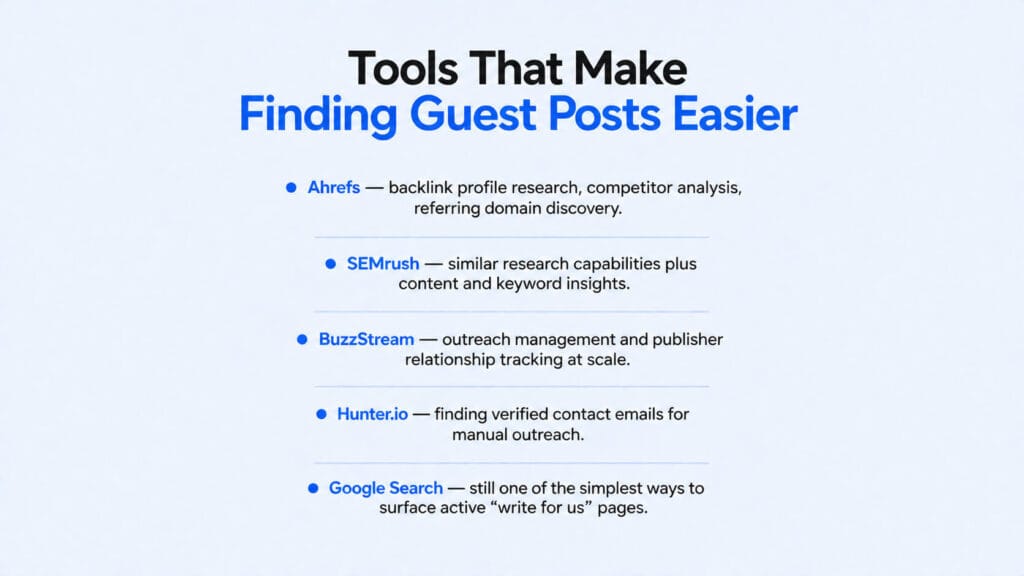
- Ahrefs — backlink profile research, competitor analysis, referring domain discovery.
- SEMrush — similar research capabilities plus content and keyword insights.
- BuzzStream — outreach management and publisher relationship tracking at scale.
- Hunter.io — finding verified contact emails for manual outreach.
- Google Search — still one of the simplest ways to surface active “write for us” pages.
Final Checklist Before Publishing
Before you submit or publish a guest post, run through this checklist:
- ✔ Site is topically relevant to your niche and target audience.
- ✔ Domain Rating and organic traffic meet your minimum standards.
- ✔ Spam score is low, and the backlink profile looks natural.
- ✔ Site has clear editorial guidelines and enforces them.
- ✔ Content is original, well-researched, and human-written.
- ✔ No keyword stuffing or overuse of exact-match anchor text.
- ✔ Anchor text and link insertion look natural in context.
- ✔ Internal and outbound links on the page are reasonable in number.
- ✔ Author bio and links are accurate and up to date.
- ✔ Content genuinely serves the site’s existing audience and search intent.
Conclusion
Guest posting in 2026 isn’t about how many guest posting websites you can get published on — it’s about how carefully you choose them. A single guest post on a relevant, high authority website with real organic traffic will consistently outperform a dozen posts scattered across low-quality guest post sites. Use the 12 methods above to build a solid list of guest post prospects, evaluate each one honestly against domain rating, spam score, and website relevance, and focus your manual outreach on placements that genuinely strengthen your topical authority, referring domains, and organic rankings.