Getting cited in Google AI Overviews isn’t about using a special AI SEO trick. Google generates AI Overviews by pulling information from multiple sources, which means your best opportunity isn’t gaming a formula — it’s creating content that is accurate, useful, easy to understand, and strong enough to stand on its own as a supporting source.
That distinction matters more than most SEO advice admits. A citation in an AI Overview isn’t the same as ranking #1 for a keyword, and chasing the two with identical tactics often backfires. In this guide, you’ll learn what an AI Overview citation actually is, how Google appears to select sources, what genuinely doesn’t move the needle, and seven practical strategies you can apply to your own content today.
Table of Contents
What Is a Google AI Overview Citation?
A Google AI Overview is an AI-generated summary that appears above traditional search results for many queries. Instead of only offering a list of blue links, Google synthesizes an answer and, in many cases, links out to the pages it drew that information from. When one of your pages appears as one of those linked sources, that’s a citation.
It’s important not to confuse this with a mention. A mention is when your brand or content is referenced without a clickable source link attached. A citation is a direct, attributable link back to your page. It’s also worth separating citation from traditional organic ranking — a page doesn’t need to hold the #1 spot to be cited, and ranking #1 doesn’t guarantee a citation either. AI Overviews and AI Mode don’t necessarily pull from identical source sets; independent analysis has found citation overlap between the two to be surprisingly low despite the answers themselves reading very similarly. That’s a meaningful opportunity: it suggests there’s more than one “winning” page per query, and being genuinely useful and well-structured can matter as much as your position on the SERP.
| Traditional Search | AI Overview |
| Ranking position | Citation / source selection |
| One result dominates | Multiple sources may be cited |
| Blue-link visibility | AI-generated answer + linked sources |
| Query ranking | Passage / source relevance |
How Does Google Choose Sources for AI Overviews?
There’s no confirmed, guaranteed formula for earning a citation, and any article claiming otherwise is overstating what’s actually known. What’s more defensible is that several content characteristics appear to make a page a stronger candidate for citation:
- Relevance to the specific query
- Overall content quality
- Source credibility and topical expertise
- Clear, direct answers rather than vague framing
- Comprehensive coverage of the topic
- Freshness, where the subject matter changes over time
- Original information not found elsewhere
- General organic search visibility
Google’s own Search documentation continues to lean on established SEO principles here — creating genuinely valuable, non-commodity content, rather than content built primarily to be “AI-friendly.” In other words, the fundamentals you’d use to earn a strong organic ranking are largely the same fundamentals that give you a shot at an AI Overview citation.
That’s an important reframe if you’ve been treating “AI Overview optimization” as a separate discipline from SEO. It isn’t. The pages most likely to be cited tend to be the same pages that would earn strong organic visibility anyway — clear, well-organized, genuinely useful, and backed by real expertise. The seven strategies below aren’t a workaround to that reality; they’re a more deliberate way of applying it.
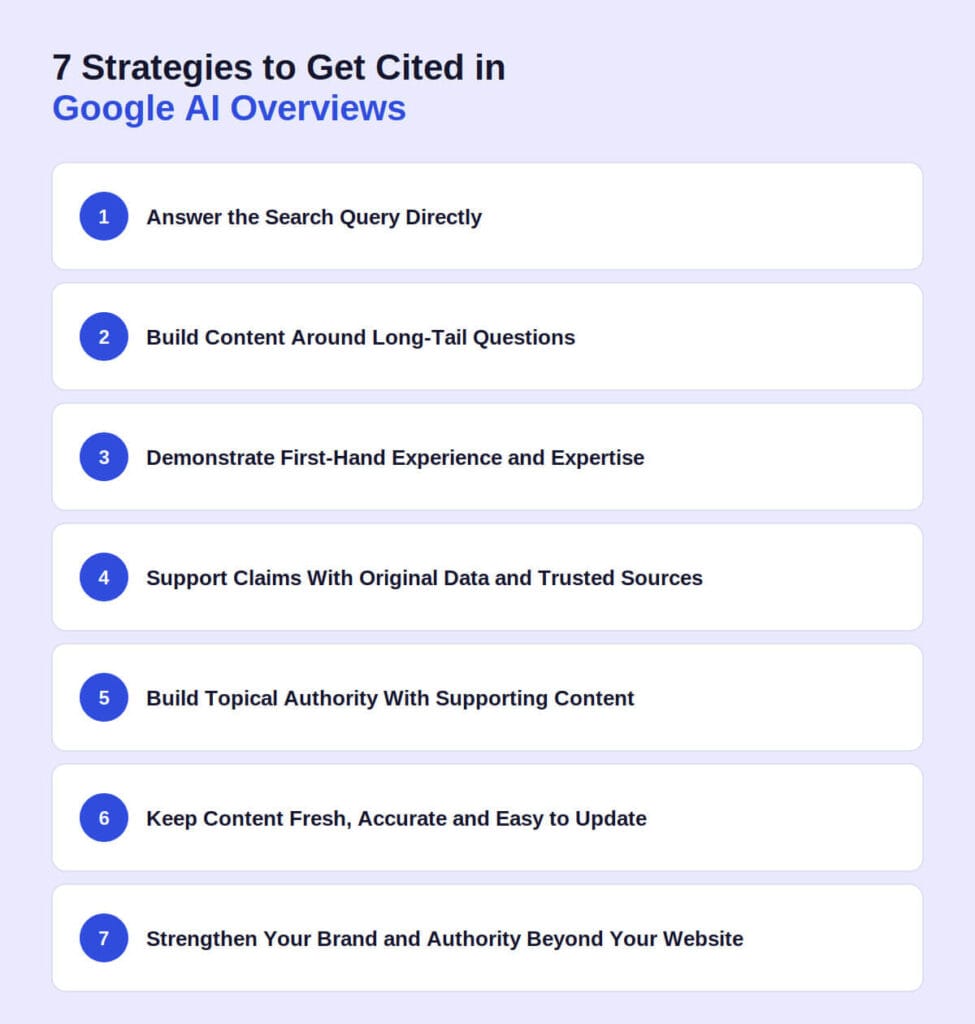
7 Strategies to Get Cited in Google AI Overviews
1. Answer the Search Query Directly
One of the simplest and most overlooked fixes is putting your answer where it can actually be found — near the top of the page, in plain language, without a long preamble.
Weak opening:
In today’s rapidly evolving digital landscape, businesses are constantly searching for new ways to improve their online visibility…
Stronger opening:
Google AI Overviews are AI-generated summaries that appear above traditional search results and can include links to supporting sources.
The second version answers the implied question immediately, then earns the right to expand with detail, examples, and nuance afterward. This isn’t just good practice for AI systems extracting passages — it’s good practice for the human reader who arrived with a specific question and doesn’t want to scroll for it.
2. Build Content Around Long-Tail Questions
AI Overviews appear especially often around informational, question-based queries — not just broad head terms. Instead of writing only around a single phrase like “AI SEO,” build out the specific questions someone in that space is actually typing or asking aloud:
- How does Google choose AI Overview sources?
- How can I improve AI search visibility?
- Can backlinks influence AI Overview citations?
- How can brands track their AI citations?
Treating these as genuine subtopics — not just keyword variations to sprinkle in — gives your page more natural surface area to be pulled into an AI-generated answer, and it aligns with how conversational and long-tail search behavior is trending across informational queries.
3. Demonstrate First-Hand Experience and Expertise
This is where E-E-A-T (Experience, Expertise, Authoritativeness, Trustworthiness) stops being an abstract acronym and starts being a practical writing decision. Instead of leaning on vague phrasing like “according to experts,” bring in:
- Author credentials
- Practical, specific examples
- Screenshots where relevant
- Real observations from your own work
- A clear methodology behind any claims
- Dated experiments or data, where available
4. Support Claims With Original Data and Trusted Sources
There’s a real gap between a generic claim and an evidenced one.
Generic: “Backlinks help AI visibility.”
Evidenced: “An analysis of tens of thousands of brands found that web mentions correlated more strongly with AI Overview visibility than raw backlink counts — while also noting that correlation doesn’t prove causation.”
The second version does more work for the reader and signals that the article is grounded in something real. When you cite outside research, favor primary and well-regarded sources — Google Search Central, established SEO research organizations, and search-industry publications — over aggregated “Google ranking factors” listicles with no clear origin. And when the evidence only shows correlation, say so plainly rather than implying a guaranteed cause-and-effect relationship.
This is also where a lot of content quietly fails. It’s easy to write “studies show” without a study behind it. If you don’t have access to a specific stat, it’s better to describe a general, well-supported pattern honestly than to invent a number that sounds authoritative. Readers — and increasingly, the systems summarizing your content — reward specificity you can actually back up.
5. Build Topical Authority With Supporting Content
A single strong article rarely creates topical authority on its own. What tends to work is a pillar-and-cluster structure: one comprehensive core page, supported by several related articles that each go deeper on a specific angle, all linked together logically.
For an “AI Search Visibility” pillar, that might look like:
- How to Get Cited in Google AI Overviews (this article)
- AI Search vs. Traditional Search
- How to Optimize Content for AI Search
- Brand Mentions and AI Search Visibility
- Digital PR for AI Visibility
Internal linking is what ties the cluster together — but more isn’t automatically better. A handful of genuinely contextual links (roughly six for a piece this length) does more for both readers and search systems than forcing in a link to every existing article on the site just because it exists. As a rule of thumb, most existing articles should earn at most one contextual link from a new piece, placed where it genuinely helps the reader go deeper — not scattered in wherever a keyword happens to match.
Over time, this cluster approach compounds. Each new supporting article you publish strengthens the pillar page, and the pillar page in turn sends relevant traffic and authority back down to the supporting content. That two-way relationship is a large part of what “topical authority” means in practice, rather than as an abstract SEO buzzword.
6. Keep Content Fresh, Accurate and Easy to Update
AI search behavior, terminology, and best practices are changing quickly, which makes stale content a real liability. Periodically revisit your published pages to check for:
- Outdated statistics
- Broken or dead links
- Old screenshots that no longer match the current interface
- Outdated Google terminology
- Claims that no longer hold up
One caution here: don’t claim that simply bumping the published or updated date improves rankings on its own — that’s not something backed by clear evidence. What’s more defensible is that regularly reviewing content for accuracy keeps it genuinely useful, which matters a great deal for a fast-moving topic like AI search.
7. Strengthen Your Brand and Authority Beyond Your Website
The final strategy extends past your own pages. Brand mentions, digital PR, contributions to relevant industry publications, and a consistent brand presence across the web all appear to play a role in how AI systems assess authority — separate from backlinks alone.
That said, be careful with the framing here. Don’t claim that more backlinks automatically produce more AI citations; that’s an overclaim the current evidence doesn’t support. A more accurate position: branded mentions across the web have shown a notably stronger correlation with AI Overview visibility than raw backlink metrics in recent research, even though correlation alone doesn’t establish causation. Building genuine authority — through outreach, expert contributions, and consistent brand information — is a more sustainable strategy than chasing link volume for its own sake.
In practice, this means digital PR and traditional link building aren’t separate tracks anymore — they’re feeding the same underlying signal. A well-placed guest post, an expert quote in an industry publication, or a mention in a relevant roundup all contribute to the same brand-authority picture that appears to influence AI-generated answers, even when the mention itself doesn’t include a direct link back to your site.
What Doesn’t Guarantee an AI Overview Citation?
- ❌ Keyword stuffing, including repeating “AI Overview” unnaturally throughout the page
- ❌ Writing specifically for AI systems instead of for the human reader
- ❌ Padding an article to 5,000 words purely for length
- ❌ Buying large volumes of low-quality backlinks
- ❌ Adding schema markup and expecting automatic citations
- ❌ Closely copying what competitors have already published
- ❌ Publishing large volumes of low-quality, AI-generated pages
The schema point deserves a specific callout: research examining nearly 1,900 pages found that adding schema markup did not meaningfully increase AI citation rates in that testing. That runs counter to a common claim in SEO content, and it’s worth stating plainly rather than repeating the myth.
How to Optimize a Page for AI Overview Citations
Use this as a practical, page-level checklist:
- Clear, descriptive title and H1
- A direct answer stated early
- Logical H2/H3 structure
- Short, scannable answer blocks
- Original insights, not just summarized third-party content
- Supporting evidence with sources linked
- Relevant internal links (not forced)
- Visible author information
- Credible external citations
- Up-to-date statistics
- Accurate, fact-checked claims
- Descriptive, relevant images
- Solid overall UX
- A genuinely mobile-friendly page
How to Track AI Overview Citations
Tracking is still an evolving, imperfect process. A reasonable manual approach:
- Identify a set of target queries relevant to your content
- Search them periodically and note when your page appears as a cited source
- Record which URLs get cited over time
- Monitor brand mentions across the web, not just backlinks
- Watch your organic rankings alongside citation appearances
- Compare what’s being cited for competitors on the same queries
- Track how citations shift over time as you update content
Don’t expect a clean, dedicated “AI Overview citation” report inside Google Search Console — as of mid-2026, industry reporting has noted that Google still doesn’t provide a standalone signal specifically for AI Overview traffic there. Third-party tools, such as Ahrefs’ Brand Radar, can help fill some of that gap, though they’re not a perfect substitute for Google’s own data.
FAQs
How do I get cited in Google AI Overviews?
Focus on directly answering specific search queries, demonstrating real expertise and experience, backing claims with credible evidence, and building topical authority through well-linked supporting content. There’s no guaranteed formula, but these characteristics consistently make a page a stronger candidate.
Can backlinks help with AI Overview citations?
They may play a role, but current research suggests brand mentions across the web correlate more strongly with AI Overview visibility than backlinks alone. Backlinks aren’t a guaranteed shortcut to citation.
Do I need to rank in the top 10 to appear in AI Overviews?
No. Citation and traditional ranking position aren’t the same thing — studies have found many cited pages don’t hold a top-10 ranking for the same query.
Does schema markup help with AI Overview citations?
Testing across nearly 1,900 pages found no meaningful increase in AI citations from adding schema. It can still help with other aspects of SEO, but it isn’t a citation shortcut.
How long does it take to appear in AI Overviews?
There’s no fixed timeline. It depends on your content’s relevance, authority, and how quickly Google’s systems reassess sources for a given query.
Can small websites appear in Google AI Overviews?
Yes. Citation appears to depend more on relevance, clarity, and credibility of the specific page than on overall site size or authority alone.
Conclusion
There’s no guaranteed formula for earning an AI Overview citation. The strongest approach is to create content that directly answers specific queries, demonstrates real expertise, supports its claims with reliable evidence, covers a topic comprehensively, and builds authority both on and off your website.
Want to improve your website’s AI search visibility? Explore Markethority SEO and link-building services.